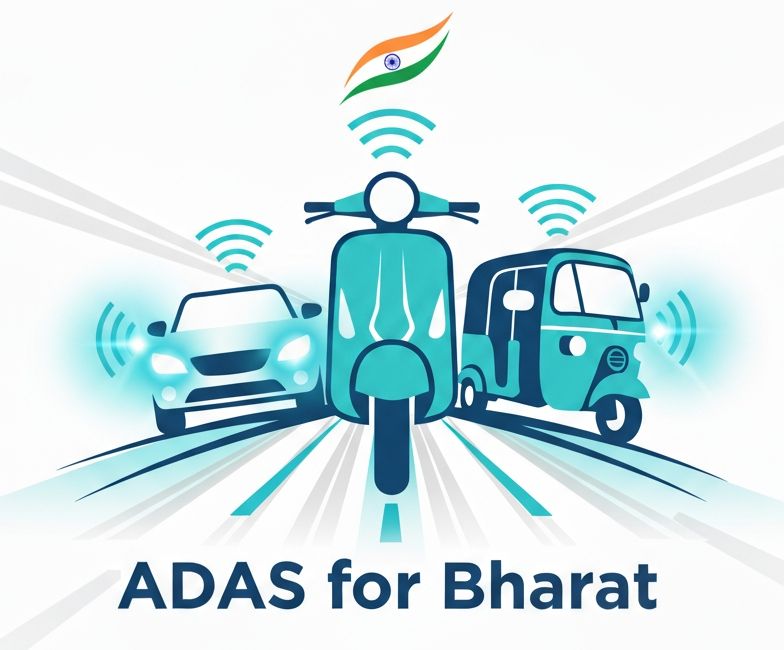
Why India Needs Its Own ADAS Story
1.55 Lakh lives lost annually on Indian roads. Global ADAS algorithms fail on chaotic streets — here is how localized perception and sensor fusion can change that.
“What if Your Car Could Save You Before You React?”
Ever wished your car could sense danger before you do? A child darts across a crowded street. A biker cuts in without warning. A truck brakes hard on a highway curve. In India, these aren’t exceptions — they’re the rule.
Now imagine if your vehicle could see, think, and act in those split seconds. That’s the promise of ADAS – Advanced Driver Assistance Systems – technology designed not to replace drivers, but to protect them.
“1.55 Lakh Lives Lost Annually — Can Technology Change That?”
Globally, ADAS has quietly transformed road safety. Features like Automatic Emergency Braking (AEB), Lane Keep Assist, and Blind Spot Detection have reduced crashes by up to 40%, according to the National Highway Traffic Safety Administration (NHTSA).
In India, road fatalities claim over 1.55 lakh lives each year — that’s 17 deaths every hour, per the Ministry of Road Transport & Highways (MoRTH) Road Accidents in India 2023 report. As India heads toward becoming the world’s third-largest car market, the question isn’t if ADAS will come — but how well it will fit Bharat’s realities.
“Chaos on Wheels: Why India Needs ADAS”
India’s driving environment is unlike any other:
- Mixed traffic: 2-wheelers, 3-wheelers, tractors, buses — all share lanes.
- Unpredictable behaviour: sudden U-turns, jaywalking, animals, parked vehicles mid-lane.
- Infrastructure gaps: faint or missing lane-markings, poor lighting, unpaved shoulders.
- Weather extremes: glare, dust, monsoon water-logging, sensor-smearing mud.
Where global ADAS systems are trained on clean, structured roads, Bharat offers a symphony of variables. An algorithm trained in Munich struggles to recognise a handcart in Mumbai.
Yet this very complexity presents a unique innovation opportunity: if we can make ADAS work here — we can make it work anywhere.
“How ADAS Sees, Thinks, and Acts”
At its core, ADAS is built on three pillars:
For India, the hardest part is perception and validation. Dust, rain, low-cost sensors, and chaotic scenes cause frequent false positives or missed detections. Algorithms trained on European datasets often misinterpret faded markings or ignore cyclists in dark clothing.
“Lessons from Europe, USA, and Japan”
In Europe, the US, and Japan, ADAS became mainstream thanks to regulation — for example, AEB became mandatory on all new passenger cars in the EU under the Vehicle General Safety Regulation (EU 2019/2144). In the U.S., consumer safety ratings (NCAP) pushed adoption by rewarding cars with strong ADAS performance.
In India, the newly launched Bharat New Car Assessment Program (Bharat NCAP) is a major step — and is progressively expanding into preventive ADAS evaluations.
“Real Lessons from Telangana: Bus ADAS Pilot”
A pilot initiative named iRASTE installed AI-enabled ADAS devices in ~200 public transport buses on three major highways in Telangana. The result: the ADAS-equipped buses experienced 40% fewer accidents than non-ADAS buses over a 12-month period.
5-Step Playbook for ADAS That Works in India
- ✅ Design for diversity — 2-wheeler, 3-wheeler, 4-wheeler, and pedestrian coexistence
- ✅ Validate for extremes — dust, monsoon water-logging, high glare, and unlined roads
- ✅ Localise perception data — train deep neural networks on Indian road datasets
- ✅ Focus on affordability — cost-optimized radar & camera hybrid architectures
- ✅ Educate drivers — technology assists the driver; it does not replace responsibility
Authentic Citations & References
- • MoRTH (2023): Road Accidents in India 2023 Report. morth.nic.in
- • NHTSA (2023): Effectiveness of Advanced Driver Assistance Systems. nhtsa.gov
- • European Commission (2019): Vehicle General Safety Regulation (EU 2019/2144). ec.europa.eu
- • Bharat NCAP (2023): Official Star Rating Programme. bncap.in
- • ThePrint (2025): Telangana Bus ADAS Pilot 40% Accident Reduction. theprint.in